
What manual order handling actually costs a New Zealand trade supplier
Most trade suppliers we talk to in Auckland know order handling is a drag on the office. Very few can tell you what it costs them in a year. It never appears as a line item. It is spread across a customer services person, a rep answering the phone in a van, someone retyping an emailed order into MYOB at 4:45pm, and the credit note that follows when a code gets keyed wrong.
So we built a calculator to turn that into a number you can take to a meeting. Three sliders, no email required: how many orders arrive by phone, email or off a price list each week, how many minutes it takes to key one in, and what an hour of that time costs you.
Have a go below. The sliders do the maths as you move them.
The number is usually bigger than people expect
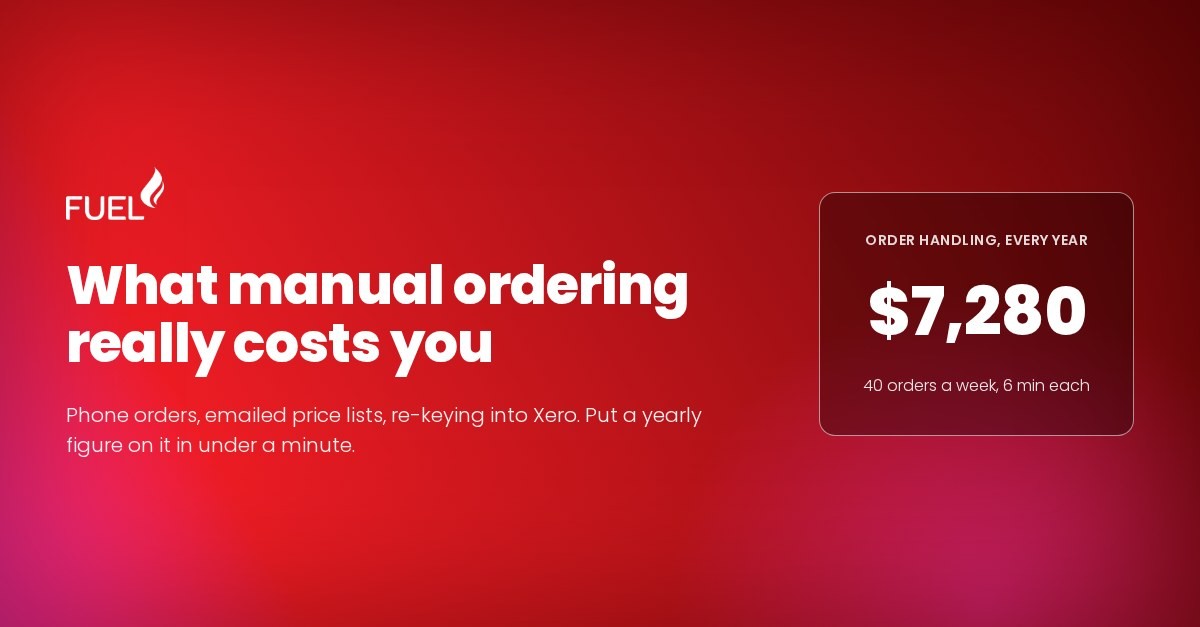
A supplier taking 40 manual orders a week, six minutes each, at $35 an hour, is spending about four hours a week on data entry. That is roughly $7,300 a year of pure typing. Nothing about that work wins an account or moves stock.
And that is only the visible part. Three costs sit underneath it.
The orders placed after 5pm
Builders, sparkies and plumbers do their paperwork at night. If your customer cannot place an order at 9pm, they either wait until Monday or they order from whoever they can reach. A portal takes that order while you are closed, at that customer's pricing, with stock already checked.
The credits and the return runs
Every retyped line is a chance to ship the wrong thing. When a customer picks from your live catalogue using your product codes, the order that arrives is the order they meant. The saving is not the typing, it is the freight, the credit note and the phone call.
It does not replace your sales team, it tells them more
The fear we hear most is that a portal puts a wall between the rep and the customer. In practice it does the opposite, as long as it is built to keep the rep in the loop.
When a customer places a purchase order online, the rep who owns that account gets notified. They can see what was ordered before they walk in the door, spot the account that has quietly stopped reordering, and notice the customer who bought three of something they normally buy twelve of. A rep who reads the portal knows more about their customers at the end of a month than one who took every order by phone, because now it is all recorded rather than sitting in someone's memory.
Reps also keep the ability to order on a customer's behalf. Same login, same pricing, done from the van, so a phone call is still a valid way to order for the customers who will never change.
What actually changes is which conversations happen. Nobody rings a rep to say "the usual again" because that is two clicks now. The calls you get are about a new product, a bigger project, a pricing question, or a problem. That is where the relationship is anyway. Routine reorders go online, rep time goes to new accounts and bigger baskets.
What a trade ordering portal actually needs to do
This is where most generic ecommerce builds fall over. Retail checkout logic does not survive contact with trade. What matters is:
- Customer specific pricing, so each account logs in and sees its own price, not RRP.
- Pack and carton quantities enforced properly, so nobody orders 7 of something that ships in 12s.
- Live stock, or at least an honest availability signal, so the portal is trusted.
- Ordering on account, with credit limits and statements, alongside card payment for cash customers.
- Freight rules that reflect how you actually charge, by weight, zone or pallet.
- Reorder from history, because most trade orders are a repeat of the last one.
- Integration with the system you already run on, usually MYOB or Xero, so orders and pricing are not maintained twice.
If a proposal you are reading does not mention account pricing, pack quantities and how orders reach your accounting system, it is a retail site with a trade label on it.
Where to start if you are not ready for the full thing
You do not have to do all of it at once, and often you should not. The cheapest first step is usually a logged in catalogue with correct pricing and reorder from history, even if stock and freight stay manual for a while. That alone takes a large share of routine orders off the phone, and it tells you which customers will adopt a portal before you spend money integrating anything.
The second stage is the accounting integration, once you can see the order volume flowing through and know it is worth automating.
Get your number checked by a human
The calculator gives you a rough figure. If you want the real one, tell us how your customers actually order and we will send back a short plain English review: what your ordering costs today, the first thing worth automating, and a real cost and timeframe for stage one so you can budget it instead of guessing. Free, no sales deck. If a portal is not worth it for you yet, we will say so and tell you what we would do instead.
We have been building ecommerce for New Zealand businesses from Auckland since 2002, including trade and wholesale suppliers running account pricing and stock integrations.
Send me the breakdown for my business
Three fields, reply within one working day. We will include your slider numbers.
Or call 09 428 3047 and ask for Jason.